Have questions about math problems, get help on this website. You will learn the toughest questions with the easiest way to solve it!!
math problems to solve
Tuesday, August 31, 2010

Christian Gladiators? Athletics as a metaphor for Christian life
Image : http://www.flickr.com

When Paul went to Corinth, in the middle of his second missionary journey, Acts 18:2-3 reports that he joined Aquila and Priscilla, manufacture of tents. This fits well with what Paul writes to himself, at the same time. For example, in 1 Thessalonians. 1:9 says, "But remember, brothers, our toil and hardship, we have worked day and night to avoid becoming a burden to anyone while he was preaching the gospel of God for you." Even in 2 Thess. 3:7-8, Paul: "Wenot idle when we were with you, even eat without paying. Instead, we worked day and night, with difficulty, so it would not be a burden to be one of you. "
Paul in these two States still at Corinth. Shortly after Corinth, left, towards the end of the third missionary journey, Paul in his apostolic right, which supported intellectually benefit (1 Co! r. 9). The question is rhetorical irony, "OrThere are only I and Barnabas who must work for a living? "(1 Cor. 9: 6).
By Jerome Murphy-O'Connor:
View of the trade the first time in a tent-maker seems particularly appropriate for a department that focuses on the city, but there was a tendency among the craftsmen of that title, though not actually covered a much broader and more ... the same purpose as a craftsman of today, sometimes described as a carpenter. Paul was in allChance, leather work, hand in producing the large number of items contained in this material: "Can [sandal] has, in turn, would gourds for water and wine, crockery saddles, shields, etc. shops and footpaths are were also made of leather, and a ready market in Corinth (St. Paul, we Corinth: Texts and Archeology, 168).
One reason for this is true is that the Games of the Isthmus took place in nearby Isthmia. After the Olympics among the four major Panhellen! icGames, Isthmian Games were two times more likely than others! , is hel d every two years. Time Paul went to Corinth, the Isthmian Games were 500 years. They were not even in the century of its tradition of welcoming Corinth was abandoned almost completely disrupted (146-44 BC).
At the time of Paul to Corinth, 50 CE, are the games have been brought from Corinth to Isthmia. Another cesarean games simultaneously with another event in every location in the isthmusGames. The Commission presented its own site of action. Groups of people from all over the Roman Empire, met Isthmia, either to participate or attend events. According to Casio, a contemporary of Paul (in his speeches, 8.12), containing the basic sporting breeds Isthmian Games, wrestling, diving, boxing, javelin throw and threw it on the disc.
One time or another in the history of the Games, including the new phenomena of horse racing, racing, poetryReading, theater, singing, announcing, playing the lyre and the flute, and a painting competition. Yacht Race, near the Saroni! c Gulf, has a function, not the Games of Olympia, Delphi, Nemea, O. Demonstrations were planned for women, like men, and even for children. Large amounts of money in hand, not only for players who have won and lost, but that gives the winner.
Isthmia excavations began in 1883 with Paul Monceaux. RenewedSB 1930 by Jenkins and H. Megawati. These initial efforts yielded only meager results. Oscar Broner, however, that the site of excavation 1959-1967 discovered the temple of Poseidon, porticoes, the sanctuary of Palaemon, two stages, much earlier than others, and a Hellenistic settlement near "Rashi". Assistant Broner, Elizabeth Gebhard outdoor theater. From 1967 to 1976, Clemente excavated Roman baths and other buildings. Ms. Gebhard againExcavated in 1980 and 1989 in the central chapel and a prehistoric settlement "Rashi".
Archaeologists were unable to find permanent housing for the crowd of participants in the Games as a track in the firs! t century AD They were built only in the second century. With ! the opti on of dealing with several miles of walking per day to reflect events or shopping and to enter a tent, hundreds if not thousands, witnessed what you prefer. In other words, this city was theBest places in the Mediterranean world of Paul to open the tent-making shop. Small shops like yours (with lines of 10 feet, 10 meters), the squares in cities throughout the Hellenistic empire.
Games of Paul, while living in Corinth? We have no idea, for sure. The games began with a sacrifice to Poseidon, the patron of the local deities. In addition, many sporting events were conducted in the most simple men and women were likelyonly poor clothing. One might expect that this nerve to offend the scruples / Judeo-Christian. However, Murphy-O'Connor said:
It is difficult to decide whether Paul himself took part in the games. Jewish Palestinian resistance against these glasses is well documented ... but we think that the same attitude that has prevailed in the di! aspora. The wire was free, I had an all-in wrestling competition (see Probis Omnis, 26), we can be sure that many Hellenized Jews did not hesitateParticipation in the Games. Jews had special reserved seats in the theater of Miletus in western Asia Minor .... (17).
We do not know for sure is that Paul uses the familiarity with the games as a source of images in their teaching. A review of his speeches and letters, in roughly chronological order, presents a series of allusions to sports competition. (I want the fat and suggestions for a more literal translation.)
Delivered before arrival in Corinth, in a sermon13h25 to Antioch in Pisidia (Acts), Paul "(race)" (Drôme greek, after "rollerdrome" and "Racetrack") as a metaphor for God's purpose for the life of John the Baptist: "And while John ended his career, he continued: "Who do you think I am? I'm not him. "
Years later, Paul us! ed the same pictures again, their objectives in life. Older Ep! hesians (Acts 20:24) was rejected, said Paul"But I think my life is worthless for me, if I can finish the race and only fill the job that I received the Lord Jesus, to testify the gospel of the grace of God."
In Galatians 2:2, Paul describes as a next visit to Jerusalem, to write together, "I. .. first to preach the Gospel, are among the nations. But I did it in private, that seemed to be transported by a fear that walking or running, he had run in vain. "Later inthe same book (5.7), commented: "You did a good race. Who cut for you and obeying the truth?"
These metaphors Paul employs, before arriving in Corinth. The longer wheelbase, however, occurs in the first Corinthians 9:24-27. Shortly after the founding of the church at Corinth, Paul urges the Corinthians:
Do not you know that running in a race all the runners, but only one receives the prize? Run, so that price. AnyoneParticipate in games goe! s into strict training. They do it to get a crown that will not last, but we do it for a crown, the eternally preserved. I can not, like a man running aimlessly, not knowing who fights like a man in the air. No, I beat my body and my slave so that after preaching to others I am not disqualified.
In previous centuries, of course, (was in greek: Stefano), the crown as a prize at Isthmia, fromThe branches of pines, like the back of the coins and find contemporary sculpture Isthmia in the sample. The crown of pine branches is a symbol of the Games of the isthmus, there was no evidence that the plant than others, Selinon (a plant similar to celery or parsley was) in the first century BC and a votive size of gains Crowns shows isthmic Selinon used in a variety of plants, including pine y. Goes particularly well with the phrase "crownno less important, or more literally, "crown perish." At the moment the isthmus that athlete! s have received their crown of grass, as it had dried.
! In seve ral letters of Paul, he uses the word "fight" or "competence" (the agon greek, that "torture" and torment. ") In Rome. 15:30, for example," Please, my brothers through our Lord Jesus Christ, the love of the mind, in my struggle with prayer to God for me to come with me. "Similar steps are presentedPaul wrote in his letters from prison (see Eph. 6:12, Col. 1:29, 2:1, 4:12, Phil 1:30) in which he wrote after (edition 1 Tim was 4.: 10, 6.12).
In one of these letters in the same prison (Phil 3:13-14), Paul Racing photos on his experience: "One thing I do: forgetting what lies behind and strain forward to what you end the sentence to which I go God in Jesus Christ in heaven. "
The word translated "reward"(In brabeion greek) is used by a greek at least three words to describe the prize to the winner of the competition. The context indicates that Paul refers to forget his su! ccesses, not the mistakes of the past. Contrary to what many preachers use this verse does not say: "Do not let your past failures discouraged by their earnings." Says the opposite: "Do not trust your" bottom line "benefits." Every race is a completely new business, and all runnersincluding the captain, must rise again. "
When Paul is back in prison shortly before his execution, he wrote in his latest letter (2 Tim. 4:7-8):
I have fought the good fight (dying), which is the rate (Drôme), I concluded kept the faith. What I have to get the crown (Stefano), the righteousness which the Lord has given me that day when the just judge, Not only has given, but all that the love of her appearance.
As in modern times, has the honor to submit the transfer higher premiums, said Paul expected Jesus, his crown will be awarded by his victory in the Christian race.
Although! this may reduce some principles, some "rules":
!
D espite the victory of Christ on the cross and his desire for forgiveness, having continued to live the Christian life to a struggle between good andMal. This is a fight with the devil, where the stakes are high and the risk of loss is real (Eph. 6:12).
God wants us to win this competition, and all terms of our success. But we must be prepared to submit to the discipline and establishing a rigorous training, if we expect (with a gain of 1 Cor. 9:24-25).
God is the price you want to be with us (Acts 20:24). The boundaries of behavior that has staked its moral is, we movebeyond the limits, if you commit sins or "sins." Within this moral line, but we must ask ourselves the same freedom of our judgments themselves, the best way to "run our race" (2 Tim. 4:7).
Death is the goal, and life with Christ in eternal prize (Philippians 3:13-14, 2 Tim. 4:8).
In the sense of the word, who are already winners, as soon a! s you start the race. In the words of Paul, who are champions of the Super, "Him who loved us" (Romans 8:37). But we still have to runthe race and to avoid being disqualified (1 Cor too. 9:26-27).
When you are in your career, Christian? Are behind the scenes? Perhaps you have doubled the last corner and stared at the finish line ahead of me. Or maybe you're still in the stands watching people in the race.
Wherever you are, the challenge of God to enter the race, all I have to run and cross the finish line victorious. Allows you to equip and train you. But it is necessaryYour role: to take seriously their Christian life, to learn all about the "rules" to listen and obey their coaches. Then, run!
Want to go further?
Here are some useful sources:
1962 Oscar Bronner. "The Crown Victoria del Istmo. American Journal of Archeology. 66:259 et seq. (See also Broner writings of many others in Isthmia.) !
1967 Pfitzner, Victor C. And the reason Paul Agon: The! images of the traditional sport Pauline literature. Leiden: EJ Brill. (Ph.D.Thesis, Faculty of Evangelical Theology in Münster, Westphalia, Germany)
1973 Elizabeth Gebhard. The theater at Isthmia. Chicago: University of Chicago.
1983 Jerome Murphy-O'Connor. St. Paul's Corinth: Texts and Archeology. Wilmington, DE: Michael Glaser.
marapets word search
Types of sets based on operations
Disjoint sets
Complement of a set
When U is the universal set and A is a subset of U, the complement of A with respect to U is denoted by A’ or A0 or U-A and it is defined as the set of all those elements of U which are not in A.
A’ = {x: x does not belong to A but x ЄU}
x ЄA’ implies x does not belong to A.
kinds of sets
Complement of a set
When U is the universal set and A is a subset of U, the complement of A with respect to U is denoted by A’ or A0 or U-A and it is defined as the set of all those elements of U which are not in A.
A’ = {x: x does not belong to A but x ЄU}
x ЄA’ implies x does not belong to A.
kinds of sets
Distance formula - Part II
Continuing from my last post, where I told you that the distance between two points can be determined by finding the length of the hypotenuse of the right angle triangle formed from the two points.


how to solve math problem
We already know that to find the length of the hypotenuse, we apply the Theorem of Pythagoras, which says that c^2 = a^2 + b^2. (The square of the hypotenuse is equal to the sum of the squares of the remaining two sides). So from this, then, we see that we need to determine the lengths of the two sides that we have created by extending lines through our points to join at a right angle. And to find these lengths, all we need to know are the coordinates of our ! 2 points!
For a general triangle, then, we have something like this:
To find the horizontal length, it is just the difference between the two x-coordinates (ie. x2-x1). Think of it as taking a stick that is x2 units long, and chopping off a length of that stick that is x1 units long. The stick that you are left with, x2-x1, is the length of our horizontal side.
The same reasoning applies to find the vertical length, which is the difference between the two y-coordinates (ie. y2-y1). One comment I will make here, is that since we are talking ab! out a length of a side, the length has to be the absolute diff! erence b etween the two points (ie. you can't have a negative side length).
So then, for our general triangle, we have our 2 lengths, and let's call the hypotenuse "d" (as in, the distance between the two points).
So then, if we apply the Theorem of Pythagoras to this triangle we have created, we can come up with the distance formula very easily!
c^2 = a^2 + b^2...... which we can change to read:
d^2 = (x2-x1)^2 + (y2-y1)^2
And so we have:
d = sqrt [(x2-x1)^2 + (y2-y1)^2]
Let's quickly try with 2 points. You can draw the triangle out as I have above to follow along more closely. I will just do the quick calculation for you though.
Find the distance between the points (1,2) and (3,5).
d = sqrt [(3-1)^2 + (5-2)^2]
d = sqrt [(2)^2 + (3)^2]
d = sqrt [4 + 9]
d = sqrt [13]
And that's all there is to it. I hope that I've been able to clearly explain how to derive the distance formula. Once you know where a lot of these formulas come from, you'll never have to worry about memorizing them again! :)
how to solve math problem
Level of measurement
The level of measurement has been classified into basically four categories. It is important for the researcher to understand that the level of measurement is determined partly by arithmetic operations and statistical operations.
Statistics Solutions is the country's leader in level of measurement and dissertation statistics. Contact Statistics Solutions today for a free 30-minute consultation.
Sorted in an ascending order of precision, the four different levels of measurement are the nominal, the ordinal, the interval and the ratio scale.
The first among the four levels of measurement is the nominal level. This level of measurement basically refers to those cases in which the numbers are used to organize the data. The use of words and letters is also done in this level of measurement. Suppose there is data that has two categories of students, na! mely weak students and strong students. Using this level of measurement, the researcher can easily classify the weak category of students with the letter ‘W,’ and the strong category of students can be denoted with an ‘S.’ This assigning of letters to distinguish the classification is the nominal level of measurement.
The second type of level of measurement is the ordinal level. This level of measurement generally involves those measurements that signify some kind of ordered associations between the number items. If four teams participate in a match, the team that has beaten all three teams would win the match and would be assigned the first rank. Then, the team performing right below the first team would be assigned the second rank, and so on. Thus, this level of measurement also assigns the reasons behind the rank assigned to any particular item. So, this level of measurement indicates the appropriate ordering of the measurements. T! he researcher should note that in this type of level of measur! ement, t he change or the share between any two types of rankings does not remain the same along the scale.
The next type of level of measurement is that of the interval level of measurement. In this level of measurement, the researcher categorizes and assigns orders to the measurements and also reveals that the distances between each interval on the scale is equivalent along the scale from the low interval to the high interval. One such example is the measurement of anxiety of a student that is in between the score of 10 and 11 is same as if the student is in between the score of 40 and 41. Another appropriate example for this type of level of measurement is that while measuring the temperature in centigrade, the distance between 940C and 960C is similar to the distance between 1000C and 1020C.
The last level of measurement is the ratio level of measurement. In this type of level of measurement, the researcher can observe a value of actual zero as well. This k! ind of phenomena is quite unlike the other types of level of measurement. However, the researcher should note that this level of measurement has the same property as that of the interval level of measurement. The divisions between the points on the scale have the equivalent distance between them, and the rankings assigned to the items are according to their size in this level of measurement.
The researcher should note that among these levels of measurements, the nominal level is simply used to classify the data, whereas the levels of measurement described by the interval and the ratio are much more exact.
free statistics help
Statistics Solutions is the country's leader in level of measurement and dissertation statistics. Contact Statistics Solutions today for a free 30-minute consultation.
Sorted in an ascending order of precision, the four different levels of measurement are the nominal, the ordinal, the interval and the ratio scale.
The first among the four levels of measurement is the nominal level. This level of measurement basically refers to those cases in which the numbers are used to organize the data. The use of words and letters is also done in this level of measurement. Suppose there is data that has two categories of students, na! mely weak students and strong students. Using this level of measurement, the researcher can easily classify the weak category of students with the letter ‘W,’ and the strong category of students can be denoted with an ‘S.’ This assigning of letters to distinguish the classification is the nominal level of measurement.
The second type of level of measurement is the ordinal level. This level of measurement generally involves those measurements that signify some kind of ordered associations between the number items. If four teams participate in a match, the team that has beaten all three teams would win the match and would be assigned the first rank. Then, the team performing right below the first team would be assigned the second rank, and so on. Thus, this level of measurement also assigns the reasons behind the rank assigned to any particular item. So, this level of measurement indicates the appropriate ordering of the measurements. T! he researcher should note that in this type of level of measur! ement, t he change or the share between any two types of rankings does not remain the same along the scale.
The next type of level of measurement is that of the interval level of measurement. In this level of measurement, the researcher categorizes and assigns orders to the measurements and also reveals that the distances between each interval on the scale is equivalent along the scale from the low interval to the high interval. One such example is the measurement of anxiety of a student that is in between the score of 10 and 11 is same as if the student is in between the score of 40 and 41. Another appropriate example for this type of level of measurement is that while measuring the temperature in centigrade, the distance between 940C and 960C is similar to the distance between 1000C and 1020C.
The last level of measurement is the ratio level of measurement. In this type of level of measurement, the researcher can observe a value of actual zero as well. This k! ind of phenomena is quite unlike the other types of level of measurement. However, the researcher should note that this level of measurement has the same property as that of the interval level of measurement. The divisions between the points on the scale have the equivalent distance between them, and the rankings assigned to the items are according to their size in this level of measurement.
The researcher should note that among these levels of measurements, the nominal level is simply used to classify the data, whereas the levels of measurement described by the interval and the ratio are much more exact.
free statistics help
March, my birthday, and I'm still here!
Hi Readers! I am still here responding to people's requests for homework help, I just don't post the answers on my blog as much anymore. But rest assured, I am still here answering your emails.
Also, to celebrate my birthday this week, I invite you to partake in this fun online gaming experience called "Auditorium"!
http://www.playauditorium.com/
I enjoyed it so much that I played it all the way through on my first sitting!
free math homework help
Helpful online videos for the Math CSET: Subtest 1 Algebra
This post is a break from the norm and just for folks taking the CSET math test. There are a few great free videos online which should help them, feel free to ignore this post if that's not you. I haven't passed the test yet myself, just wanted to save other folks some time by getting you to what I think is the good stuff. After I pass part 1 I will move on to the Geometry/Probability, Subtest II, and maybe will post more links then.
First I wanted to share my understanding of the current rules in CA, and what I'm up to. Skip down to get to the links. Please don't take this as final advice, as things are so convuluted that I could be wrong. If you see some glaring error please let me know.
So that said, with the NCLB rules now, taking the higher math courses themselves at a college is pretty worthless as far as getting a hireable credential for those who currently just have a multiple-subject credential, at least the way credentials go in Californi! a. For elementary teachers if you do already have a certain amount of upper math coursework you can get something called a Math authorization added to your credential which enables you to teach Math in grades 9 and below, but that's it. It isn't NCLB compliant and it is unlikely any high school will hire you as you can't teach above grade 9.
Now, if you get the Foundational Math add-on, you can teach any grade level, you just can't teach AP higher level courses. Plus it is NCLB compliant. That encompasses about 95% of the math taught in the state. To get the Foundational Math added on to an Elementary/Multiple Subject Credential you need to pass the first two parts of the CSET single subjects math test, plus take a class on Math teaching methods if you haven't already.
So my point is, why go to math classes if you will need to take the tests anyway to get a math teaching job? Buy a cheap used College Algebra textbook and accompanying solutions m! anual, and download some free lecture videos to help you out. ! Do thin gs on your own schedule, you're a teacher after all and should be able to teach yourself a thing or two.
It is a bit hard to find good videos though or specific resources. A google search for help on CSET Math will lead you to all sorts of con-artists selling you generic test-prep garbage and worthless non-interactive software. Almost none of them are finely tuned to what you need on the very difficult CSET math test. You know the garbage I mean, half the book discussing how you need to get a good night's sleep before the test, don't leave anything blank, that sort of crap. Stuff you better already know if you are at this level anyway. Plus the Algebra on the test is nothing like what you took in high school, it is advanced stuff.
The only specific CSET math printed prep resource that I've heard is good are the study guides offered by Orange County here: If you plan to study a random math book? Well it! had better be a tough college one. Advanced Algebra or PreCalculus. The best targeted online site is from UCIrvine here. There are some videos out there which I won't mention because they seem to completely evolve around graphing calculators and how to use them to do the work for you. As you know you can't use a calculator on CSET subtest 1.
So finally the great free videos I have found for CSET Subtest 1: Algebra are:
College Algebra lectures from Utah Valley University
College Algebra Lectures from University of Missouri
College Algebra and Precalculus Video Tutorials in Realplayer format from Tallahassee CC
University of Idaho has some short little Algebra clips which I only watched briefly but look promising here
Precalculus Lectures from North Carolina State
Annenberg Media has a good series called Algebra: In Simplest Terms
So good luck with the test, know that it takes lots of time to prepare if! you are as math deprived as me.
free algebra tests
First I wanted to share my understanding of the current rules in CA, and what I'm up to. Skip down to get to the links. Please don't take this as final advice, as things are so convuluted that I could be wrong. If you see some glaring error please let me know.
So that said, with the NCLB rules now, taking the higher math courses themselves at a college is pretty worthless as far as getting a hireable credential for those who currently just have a multiple-subject credential, at least the way credentials go in Californi! a. For elementary teachers if you do already have a certain amount of upper math coursework you can get something called a Math authorization added to your credential which enables you to teach Math in grades 9 and below, but that's it. It isn't NCLB compliant and it is unlikely any high school will hire you as you can't teach above grade 9.
Now, if you get the Foundational Math add-on, you can teach any grade level, you just can't teach AP higher level courses. Plus it is NCLB compliant. That encompasses about 95% of the math taught in the state. To get the Foundational Math added on to an Elementary/Multiple Subject Credential you need to pass the first two parts of the CSET single subjects math test, plus take a class on Math teaching methods if you haven't already.
So my point is, why go to math classes if you will need to take the tests anyway to get a math teaching job? Buy a cheap used College Algebra textbook and accompanying solutions m! anual, and download some free lecture videos to help you out. ! Do thin gs on your own schedule, you're a teacher after all and should be able to teach yourself a thing or two.
It is a bit hard to find good videos though or specific resources. A google search for help on CSET Math will lead you to all sorts of con-artists selling you generic test-prep garbage and worthless non-interactive software. Almost none of them are finely tuned to what you need on the very difficult CSET math test. You know the garbage I mean, half the book discussing how you need to get a good night's sleep before the test, don't leave anything blank, that sort of crap. Stuff you better already know if you are at this level anyway. Plus the Algebra on the test is nothing like what you took in high school, it is advanced stuff.
The only specific CSET math printed prep resource that I've heard is good are the study guides offered by Orange County here: If you plan to study a random math book? Well it! had better be a tough college one. Advanced Algebra or PreCalculus. The best targeted online site is from UCIrvine here. There are some videos out there which I won't mention because they seem to completely evolve around graphing calculators and how to use them to do the work for you. As you know you can't use a calculator on CSET subtest 1.
So finally the great free videos I have found for CSET Subtest 1: Algebra are:
College Algebra lectures from Utah Valley University
College Algebra Lectures from University of Missouri
College Algebra and Precalculus Video Tutorials in Realplayer format from Tallahassee CC
University of Idaho has some short little Algebra clips which I only watched briefly but look promising here
Precalculus Lectures from North Carolina State
Annenberg Media has a good series called Algebra: In Simplest Terms
And finally for the more difficult Abstract Algebra portion of the test, which I'm currently having a hard time wrapping my brain around, this series looks like it should help out:
Harvard's Abstract Algebra Course
And last but not least, the brilliant Gilbert Strang of MIT and his Linear Algebra lectures. You also need to know some of the basics of Linear Algebra for the CSET, you will get sucked into watching all of these though as Gilbert keeps you on the edge of your seat with his brilliant delivery.
Harvard's Abstract Algebra Course
And last but not least, the brilliant Gilbert Strang of MIT and his Linear Algebra lectures. You also need to know some of the basics of Linear Algebra for the CSET, you will get sucked into watching all of these though as Gilbert keeps you on the edge of your seat with his brilliant delivery.
In iTunes podcasts and iTunes U there are many mini-lessons that are also helpful, short five minute examples on various topics. There are tons of those, so I will just let you search iTunes on your own for those. Most of the above you can download and then watch at your convenience. Some you have to stream and watch in your browser. (Unless you have the know-how on how to grab them.)
So good luck with the test, know that it takes lots of time to prepare if! you are as math deprived as me.
free algebra tests
LUCKY NUMBER 1
NOW LET US LEARN HOW TO KNOW OUR LUCKY NUMBER
First of all, we should have our correct Date of Birth to know the correct lucky number.
Note: For the people, who do not know their correct date of birth, I will tell other way to know their lucky number, later on, in these columns.
LUCKY NUMBER 1
For example: Your date of birth is: 10th January 1971
In this case, first we should take only the date and leave the rest of others such as Month and Year. OK.
Now the date in the above example is: 10th. It means: the lucky number here is: 1. This is called Basic Lucky Number.
How to bring your lucky number to a single digit? It is very simple calculation. For example the dates in a month such as: 1st, 10th, 19th and 28th are to be brought to a single digit number. The 1st is a single digit; we need not bother about it. The 10th is to be divided by 9 and the remainder is 1, hence this is the lucky number for 10. Like that the other number 19, it should be divided by 9, and remainder is 1. This is the lucky number for 19. In the case of 28th, 9 should divide it and the remainder is 1. So, the remainder is again 1. Like this all other dates can be calculated to get your lucky number.
You may easily calculate your lucky number on your own, basing on the above calculations.
We have given lucky number for Number 1 persons i.e. 1st, 10th, 19th and 28th in a month.
TO SUM UP
1) 1st date is = 1
2) 10th date is = divide it by! 9 = rem ainder is = 1
3) 19th date is = divide it by 9 = remainder is = 1
4) 28th date is = divide it by 9 = remainder is = 1
In the forth-coming lessons, we will give calculations on how to know other lucky numbers, one by one.
Here, I will update every week with a lucky number’ details. So after sometime other lucky numbers will be covered.
Readers are requested to post their comments.
dividing three digit single digit number
Formula for Sine


In this blog we are going to learn about formula for sin and sin rule formula.
Definition for sine:Based on tringle.
Formula to do Sine.
- Sin(x+y) = sin(x) cos(y) + cos(x) sin(y).
- Sin(x-y) = sin(x) cos(y) – cos(x) sin(y).
- Sin (2x) = 2sin(x) cos(x).
These are the formula for sine.Now get some knowledge on sine rule.
A sine rule is a formula which is used to findout the unknown in a non right triangle. Sine rule is about an equation in which relating to side length and angle of a triangle. Sine rule is also known as Law of sines.
Here is the sine rule formula.
Sin(A)/a= sin(B)/b=sin(C)/c
This is the sin rule formula .Next time we will learn some solved problem! s on for mula for sine and sine rule based problems.
Learn Sine Rule
I Dream of Similar Triangles
Has anybody else ever had nightmares about the SATs? Not just taking them or whatever, but about the subjects on the test? I keep having nightmares about geometry.
Anyway, due to my SAT-related insomnia, I changed all the colors on the blog. Hope y'all weren't too attached to the old ones, because I have no idea how to get it back to normal.
Goodnight, all!
similar triangles
Anyway, due to my SAT-related insomnia, I changed all the colors on the blog. Hope y'all weren't too attached to the old ones, because I have no idea how to get it back to normal.
Goodnight, all!
similar triangles
New Blog
I won't be writing a ton here until I'm back in the classroom, and that won't be for awhile : )
Prime and composite numbers
If you do want to keep up with me, I'm writing about my sweet girl and life as a new mom over here: The New Mommy Files: Memories, Missteps, and Milestones. Otherwise, I'll catch you all when Annabelle is old enough for Children's House and I emerge from my blissful stay-at-home-mom cocoon!
Be well!
Prime and composite numbers
Gadgets, Games and Gizmos: Learning Multiplication Tables in a Game
There are video game based learning tools for a variety of topics including Algebra and Spanish. Here is one for multiplication tools.
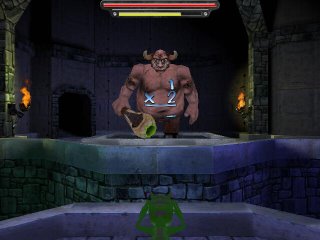

Download a free demo version today and play it to see how fact-based learning can be incorporated into a video game format and, if you have kids, use it to teach them multiplication.
__
Recommended Games and Gadgets
Recommended Books
Content Guide
Learning multiplication tables


Timez Attack is a new video game instructionally designed exclusively for Learning multiplication tables. The game uses drill and practice disguised as a video game (as we know Drill and practice is an effective strategy for teaching facts, like the multiplication tables).
Using a first person genre, the game provides a graphically high-quality adventure where the learner travels from one location to another solving multiplication problems. Solving a problem opens a door, defeats a monster, reveals a key or otherwise advances the young player's cause. The game has various levels to keep the kids interested. It is a lot more fun than flash cards and more motivating.
The first level is a dungeon that gives you a feel for the controls and the game play. This level is straightforward and helps the child to learn how to navigate through the game.
The space level has some trick floors and other obstacles that you have to navigate or start over.! I fell victim to the traps a few times. What I like about the! game is that it engages the learner and forces him or her to drill on the multiplication tables and, at the end of a level, you face a level boss who forces you to review everything you learned on that level. In essence it is a mastery review test and, if you miss a problem while battling the creature, you have to go back and practice.
You'll have to check out the game yourself to see the "hot" third level.
My nine year old played the game and had a lot of fun (although, he is already well versed in the multiplication tables). He said that it would be great for a second grader or early third grader (he is in fourth). This is a good example of how a drill and practice exercise can be made into a fun game.
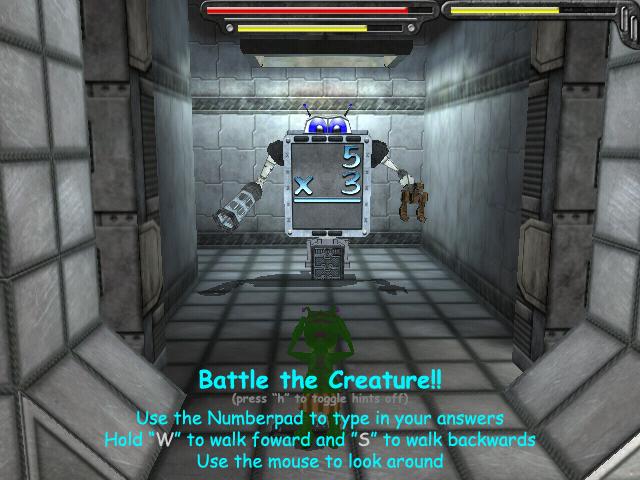
Download a free demo version today and play it to see how fact-based learning can be incorporated into a video game format and, if you have kids, use it to teach them multiplication.
__
Recommended Games and Gadgets
Recommended Books
Content Guide
Learning multiplication tables
Adding Fractions
Pattern blocks are incredibly useful learning tools! Today and yesterday we used them to expand our knowledge of fractions. If a yellow hexagon is the whole, then a green triangle is 1/6 because it takes 6 green triangles to evenly fill up a hexagon. Similarly, a blue rhombus is 1/3 because it takes 3 blue rhombi to evenly fill up a hexagon. Finally, a red trapezoid is 1/2, because it takes 2 red trapezoids to evenly fill up a hexagon.
As children manipulated the blocks, they realized they could fill a hexagon using a combination of blocks. For example, you can fill a hexagon with 1 trapezoid, 1 blue rhombus and 1 green triangle. Therefore, we know that 1/2 + 1/3 + 1/6 = 1. We talked about adding fractional pieces. We learned that we can only add fractions (in our head) if the denominators are the same. For example, we can add 1/4 + 2/4 = 3/4. The denominator of 4 is consistent. In the example 1/2 + 1/3 + 1/6 = 1, the children used a model (the blocks) to solve i! t. They would not be able solve it mentally because the denominators are not the same. However, some very smart third graders realized that 1/3 + 1/6 = 1/2 (because 1/3 = 2/6) so the same problem can also be solved 1/2 + 1/2 = 1. (Sounds like fifth grade fraction studies, don't you think?)
Challenge your child to solve these addition and subtraction problems:
1/3 + 1/3 =
3/4 + 1/4 =
5/6 - 3/6 =
3/5 - 1/5 =
adding fractions help
As children manipulated the blocks, they realized they could fill a hexagon using a combination of blocks. For example, you can fill a hexagon with 1 trapezoid, 1 blue rhombus and 1 green triangle. Therefore, we know that 1/2 + 1/3 + 1/6 = 1. We talked about adding fractional pieces. We learned that we can only add fractions (in our head) if the denominators are the same. For example, we can add 1/4 + 2/4 = 3/4. The denominator of 4 is consistent. In the example 1/2 + 1/3 + 1/6 = 1, the children used a model (the blocks) to solve i! t. They would not be able solve it mentally because the denominators are not the same. However, some very smart third graders realized that 1/3 + 1/6 = 1/2 (because 1/3 = 2/6) so the same problem can also be solved 1/2 + 1/2 = 1. (Sounds like fifth grade fraction studies, don't you think?)
Challenge your child to solve these addition and subtraction problems:
1/3 + 1/3 =
3/4 + 1/4 =
5/6 - 3/6 =
3/5 - 1/5 =
adding fractions help
Geometric Construction and the Sinus Function
Today I have a fantastic question from Yahoo Answers about geometric construction. The idea of geometric construction is to use a compass and a ruler (with no measurements) to construct different geometric shapes and figures.
Notice: to answer this question you need to know basic constructions: copying a segment, creating a segment X times larger than another, find a perpendicular bisector, and copy an angle. Without those you'll be lost.
Here is the question:
A triangle has sides a, b, and c. The ratio a/b = 7/4. You are given side c and the radius of the circumcircle, r. Construct the triangle.
This may seem simple, but it's a little more sophisticated than that. To construct that triangle, we need the law of sines.
The law of sines says that in a triangle, a/sin A = b/sin B = c/sin C = 2R (side a and angle A are opposite, R is the radius of the circumcircle). Let's play with this l! aw a little:
a/sin A = b/sin B
That means:
a/b = sin A / sin B
In our triangle, a/b = 7/4. So all we need to do is find two angle whose ratio of sines is 7/4. So how do we do that?
The definition of sine A is the y-coordinate on the unit circle with the angle measure of A (read here about the unit circle). First, construct two segments, a' and b' in a way that a'/b' = 7/4. Now create a circle with a radius of more than a' and two perpendicular axes that intersect at the center of the circle. Position a' in the circle in such a way that it's perpendicular to the x-axis and touches the circle in one point (yet not tangent to it). Construct the line from the origin to the point of intersection of a' and the circle. Call the angle between the x-axis and that line angle A. Do the same thing for b' and angle B.
Since we used the definition of sine, we now have two angles with a ! sine ratio of 7/4. Now we need to create the triangle we want.!
First, construct segment c. Since the circumcenter, the center of the circumcenter, is on the point of intersection of all perpendicular bisectors, construct the perpendicular bisector of segment c. Now, since the radius is given, use the end point of segment c and the perpendicular bisector to find the circumcenter and draw the circumcircle.
Now, when segment c is inside the circle, copy angle A to one of its sides and angle B to the other side. Complete the triangle, and you are done.
Feel free to send in more questions!
Nadav
nadavs
Geometry Construction Answers
Drawing WPF Curves with Arrow heads
Having drawn the shapes, the curves and found their intersection point, I finally needed to draw an arrow head. In order to draw the arrow at the right angle we need to know the tangent of the Bezier curve at the intersection point. Since that is beyond my maths capability I chose to find the intersection point between the line and an imaginary, slightly larger, rectangle that surrounds the target shape. The difference between the two intersection points provides the required angle for the arrow head.
private static void DrawArrowHead(Canvas canvas, PathGeometry linePath, Rect shapeRect, Color color)
{
   // Get the intersection point of the imaginary, slightly
   // larger rectangle that surrounds the targer shape.
   Rect!   outerRect = new Rect(shapeRect.Left - 10, shapeRect.Top - 10, shapeRect.Width + 20, shapeRect.Height + 20);

   RectangleGeometry shapeGeometry = new RectangleGeometry(shapeRect);
   Point[] intersectPoints = GetIntersectionPoints(linePath, shapeGeometry);


   double innerLeft = intersectPoints[0].X;
   double innerTop = intersectPoints[0].Y;


   shapeGeometry = new RectangleGeometry(outerRect);
   intersectPoints = GetIntersectionPoints(linePath, shapeGeometry);


   double outerLeft = intersectPoints[0].X;
   double outerTop = intersectPoints[0].Y;


   Polygon arrowHead = new Polygon();
   arrowHead.Points = new PointCollection();
   arrowHead.Points.Add(new Point(innerLeft, innerTop));
   arrowHead.Points.Add(new Point(innerLeft + 10, innerTop + 5));
   arrowHead.Points.Add(new Point(innerLeft + 10, innerTop - 5));
   arrowHead.Points.Add(new Point(inner!  Left, innerTop));
   arrowHead.Stroke = new SolidColorBru!  sh(color );
   arrowHead.Fill = new SolidColorBrush(color);


   // The differences between the intersection points on
   // the inner and outer shapes gives us the base and
   // perpendicular of the right-angled triangle
   double baseSize = innerLeft - outerLeft;
   double perpSize = innerTop - outerTop;
   // Calculate the angle in degrees using ATan
   double angle = Math.Atan(perpSize / baseSize) * 180 / Math.PI;


   // Rotate another 180 degrees for lines in the 3rd & 4th quadrants
   if (baseSize >= 0) angle += 180;


   // Apply the rotation to the arrow head
   RotateTransform rt = new RotateTransform(angle, innerLeft, innerTop);
   arrowHead.RenderTransform = rt;


   // Arrow heads are drawn over the lines but
   // under the shapes
   Canvas.SetZIndex(arrowHead, (int)Layer.Arrow);


   canvas.Children.Add(arrowHead);
}

Find the Angle of Intersection between Curves
Distance formula - Part I
This post is going to explain the distance formula... what it is, and where it comes from. When you see how to derive it, you won't need to worry about memorizing the formula anymore. And it's much easier than you think, despite looking kind of scary.

formula of distance
The distance formula can best be explained with a right angle triangle.
Assume that you want to find the distance between 2 points... if you extend a horizontal line across from one point, and a vertical line through the other, these two lines will intersect at a right angle. You can then imagine the hypotenuse of this right angle triangle to be the distance between the 2 points in question.
From this, you can see that the distance between the two points is simply the length of the hypotenuse. Move ahead to the next page, where I will describe the formula that we need!
formula of distance
How to Graphing Inequalities in the Coordinate Plane.
- Graph inequalities in a xy coordinate graph.
Assumptions:!
Ability to graph a line using the slope-intercept form (y = mx + b)
Concepts:
- The shaded area of a graph represents all of the coordinates that will work in a given equation.
- A solid edge of the shaded area means that the e! dge is part of the solutions to the equation.
- A dashed edge of the shaded area means that the edge of the graph is not part of the solutions.
Directions:
Graph the equation 
Step 1: Draw the graph just as you would y = x . This equations in slope intercept form would look like this  . The 0 means that you will go through the origin, place a point there. Now use the slope to draw the rest of t! he line. From the origin go up one and to the right one and pl! ace anot her point. Repeat until you have several points.

Now draw a solid line because the equation to be graphed is greater than or equal to. Your graph should now look like this:

Step 2: Next shade everywhere above the line because the equation states that the y values are greater than or equal to the line for any given x value.

Now check your answer by inserting a couple of points from the shaded area and non-shaded area.
Shaded
Does the point ( 1, 2) work in the equation? yes 
Does the point ( -1, 0) work in the equation? yes 
Non-shaded
Does the point ( 1, 0) work in the equation? no 
Does the point ( 2, 1) work in the e! quation? no 
Lets try another one.
Graph graph y > 2x + 3
Remember the steps: plot some points, draw the line (solid if equal to, dashed if greater than or less than), shade above with greater than, shade below with less than.
The line will cross the y axis as 3 then go up 2 and over 1 for the slope. Start by placing a point at 3 on the y axis. Next use the slope to place 2 more dots, then make a dashed line through the dots.


The equation uses the greater than inequality so it should be shaded above the line.

Now that we have the common ones out of the way lets look at the ones that may trip you up such as the ones with only one variable like y > 2 and x < -3.
Graph y > 2
Remember that is just a horizontal line. This is just a horizontal line that is shaded above the line and dashed because it is not equal to the line it is only greater than the line.
Graph x < -3
Remember that is just a vertical line. This is just a vertical line that is shaded to the left of the line and dashed because it is not equal to the line it is only less than the line. The x values on the left are less than the line.

Things to remember when graphing inequalities:
≥ Solid line and shaded above the line.
≤ Solid line and shaded below the line
> Dashed line and shaded above the line
y > # Horizontal line and shaded above the line
y < # Horizontal! line an d shaded below the line
x > # Vertical line and shaded on the right side of the line
x < # Vertical line and shaded on the left side of the line.
algebra 2 answer generator
Problem 444: Tangent circles, Secant line, Chords, Angles, Congruence
Geometry Problem
Click the figure below to see the complete problem 444 about Internally Tangent circles, Secant line, Chords, Angles, Congruence.
See also:
Complete Problem 444
Level: High School, SAT Prep, College geometry

geometry circles
Distance formula - Part II
Continuing from my last post, where I told you that the distance between two points can be determined by finding the length of the hypotenuse of the right angle triangle formed from the two points.
Angle of Intersection between Curves Questions
We already know that to find the length of the hypotenuse, we apply the Theorem of Pythagoras, which says that c^2 = a^2 + b^2. (The square of the hypotenuse is equal to the sum of the squares of the remaining two sides). So from this, then, we see that we need to determine the lengths of the two sides that we have created by extending lines through our points to join at a right angle. And to find these lengths, all we need to know are the coordinates of our ! 2 points!
For a general triangle, then, we have something like this:
To find the horizontal length, it is just the difference between the two x-coordinates (ie. x2-x1). Think of it as taking a stick that is x2 units long, and chopping off a length of that stick that is x1 units long. The stick that you are left with, x2-x1, is the length of our horizontal side.
The same reasoning applies to find the vertical length, which is the difference between the two y-coordinates (ie. y2-y1). One comment I will make here, is that since we are talking ab! out a length of a side, the length has to be the absolute diff! erence b etween the two points (ie. you can't have a negative side length).
So then, for our general triangle, we have our 2 lengths, and let's call the hypotenuse "d" (as in, the distance between the two points).
So then, if we apply the Theorem of Pythagoras to this triangle we have created, we can come up with the distance formula very easily!
c^2 = a^2 + b^2...... which we can change to read:
d^2 = (x2-x1)^2 + (y2-y1)^2
And so we have:
d = sqrt [(x2-x1)^2 + (y2-y1)^2]
Let's quickly try with 2 points. You can draw the triangle out as I have above to follow along more closely. I will just do the quick calculation for you though.
Find the distance between the points (1,2) and (3,5).
d = sqrt [(3-1)^2 + (5-2)^2]
d = sqrt [(2)^2 + (3)^2]
d = sqrt [4 + 9]
d = sqrt [13]
And that's all there is to it. I hope that I've been able to clearly explain how to derive the distance formula. Once you know where a lot of these formulas come from, you'll never have to worry about memorizing them again! :)
Angle of Intersection between Curves Questions
3rd grade word problem
Introduction to 3rd grade word problem:
In this section let me help you on word problems 3rd grade. In mathematics term, especially in the area of abstract algebra known as combinatorial group theory, the word problem for a recursively presented group G is the algorithmic problem of deciding whether two words represent the same element. The addition word problems means that it a simple addition of the concepts from real-life situations. Year one children has very interactive method of learning.
Example for 3rd Grade Word Problems:
3rd grade word problem -
Example:
In the fruit seller had 542 apples. He sold 142 apples. How many apples did he have left?
Solution:
Seller 542 apples
Sold 142 apples
Left apples =? This could also help us on square roots calculator
So, 542 – 142 = 400
He had totally 400 apples left.
Keep reading may be in the next session let me help you on oblique triangle
online geometry help
In this section let me help you on word problems 3rd grade. In mathematics term, especially in the area of abstract algebra known as combinatorial group theory, the word problem for a recursively presented group G is the algorithmic problem of deciding whether two words represent the same element. The addition word problems means that it a simple addition of the concepts from real-life situations. Year one children has very interactive method of learning.
Example for 3rd Grade Word Problems:
3rd grade word problem -
Example:
In the fruit seller had 542 apples. He sold 142 apples. How many apples did he have left?
Solution:
Seller 542 apples
Sold 142 apples
Left apples =? This could also help us on square roots calculator
So, 542 – 142 = 400
He had totally 400 apples left.
Keep reading may be in the next session let me help you on oblique triangle
online geometry help
Algebra 1 curriculum advice
I have just finished writing a LONG article on homeschool algebra 1 recommendations and advice. It took me quite many hours to write and research.
Questions about what to do for algebra 1 have become one of the "frequently asked questions", so I decided to write down something that I can refer people to, from now on.
I realize you may have different opinions and even suggestions for algebra curriculum in homeschool, so if you let me know, I'm willing to look into other possibilities not mentioned in the article.
solve algebra 1 problems
Two Year Algebra - Reboot
Struggling students can succeed in Algebra and complete high school.
Approach
- Organize a voluntary PLC of math teachers to pursue the pre-selected approach
- Consider looping for ninth-tenth grade.
- Use a reform math text - dramatically different from the district's standard text
- Grade Summative Assessments on a curve of highest eighth = A, offset quartiles = B, C, D. If this is too drastic, then the PLC-advocated college grading scale of 75-100 is an A, 50-75 is a B, and 25-50 is a C may be appropriate.
- Bottom eighth can earn a grade or pass by teachers's judgment or completion of alternative work such as ALEKS or StudyIsland or Algebra games like Dimension X/U or re-exam; even if semester has ended.
- Bottom eighth cannot be determined until final for student motivation
- Course starts with Assessment: Students scoring low that ALEKS Algebra Prep for Six Weeks
- "Homework" completed in class as PRACTICE - careful attention paid to technique
- Calculators used for most problems (some no calculator to mimic CST)
- Supplements such as online formative assessment and/or Gizmos and/or Wolfram|Alpha or Akron.
- Cultivate student growth mindset by using Brainology.
- Experiment with DimensionU online math video game.
- Its About Time's Math Connections - not enough state standards may be an issue.
- CPM - After 20 years, it now has state approval after changes - 1993 attack
- Contract with Heymath! - other districts may have done this already.
- Kinetic Books or NROC's new program, when available
- Supplement current practice with a sequence of online manipulatives (eg Mathematica and Gizmos) coordinated with professional development and a PLC to determine sequence.
- Sharp WriteView
- Casio Natural Display
- TI/Casio Graphing Calculator, if text driven (Connections requires one)
- More than one text can be selected depending on the number of teachers that volunteer and their interests.
- CPM is used by 2-year Algebra programs where students alternate days of doing "homework" in class. CPM claims that no supplementary materials are needed. CPM, a non-profit, has an exceptionally low cost program:
- August 2-6 - teacher training in Irvine at No Charge
- Teacher text is $95 and each paperback, 3-hole punched, re-usable student text is $18
- Classroom set of Algebra tiles is $97
- 2" loose-leaf binder for text and notes: $1 in volume
- CPM has been used at Irvine's Northwood for six years. In one-year classes, CST proficiency has increased from 30% to 80%. In two-year classes, CST proficiency has increased from 6% to 24% and may be higher this year. The main reason Irvine adopted CPM was to give their students a different look at Algebra from the standard texts. CPM is also used by Northwood for Honors Geometry and Honors Algebra 2. I used CPM Geometry briefly at University High as a substitute. The question quality was quite high.
- Heymath! has asked us to proceed. We would want to send them the Algebra AB pacing plan. The Massachusetts and Connecticut experiences show this can be fruitful.
- For Kinetic Books: To track student progress through the Algebra text and do online homework, you will want copies for the individual students. This would be the Class Set License, which is $49.95 per student.
- Putting a Computer Lab License on some of the computers at school would allow them to do online homework while at school, but you wouldn’t be able to track their progress through the book itself.
- Online homework is $10.00 per student. Given your situation, I’m not sure you would be doing that on a regular basis.
- Given the above you have a few choices:
- If the Computer Lab License only, the students can use the text, but you don’t get any scoring information for them.
- Use the Computer Lab License with online homework. With this you can track what the students do for homework that you assign.
- Get Class Set Licenses for each of the students. This allows you to track their progress through the book and they can work at home.
- The Class Set License plus online homework gives you the functionality tracking progress through the text as well as any homework you assign from the online homework system.
algebra 2 online
Work Problem 5
The following was a question a anonymous visitor asked: Jim can fill a pool carrying buckets of water in 30 minutes. Sue can do the same job in 45 minutes. Tony can do the same job in 1 ½ hours. How quickly can all three fill the pool together?
Work problem 5 solution here
algebra word problems solved
Time and Distance Problem 12
This is a algebra time and distance problem asked by an anonymous user in the ask a question section which stated,
"A boat travels 10 km upstream and 10 km back. The time for the round trip is 10 hrs. The speed of the stream is 4 km/hr. What is the speed of the boat in still water? Can someone help? I need it as a decimal."
Answer Coming Soon!
algebra word problems free
Online Homework: WebAssign
Here's this afternoon's presentation about Online Homework Systems and WebAssign for the panel discussion at MathFest 2008 in Madison, Wisonsin.
Uploaded on authorSTREAM by wyandersen
calculus homework online
Calculus learning
Writing here is becoming a thing of interest for me as along with giving you some help i am also helping myself. Last time i shared with you how to get fraction help and today i will concern to calculus help.
So here i will try to help you with some free calculus help. Calculus is the excogitate of modify. Stone has distributed covering in areas equal Study and Bailiwick. Since the larn of Concretion is pivotal in ramous out to opposite fields, it is influential to get the best Incrustation meliorate redress from the formative period itself.
Calculus being a important part of math problem, knowing it clearly is a important thing. And also i will suggest you to learn from the basics as it would allow you to have a strong hold.
I hope this piece of wr! iting will be helpful to you. Next time i will proceed with some other help. Do post your comments.
calculus problems solved
So here i will try to help you with some free calculus help. Calculus is the excogitate of modify. Stone has distributed covering in areas equal Study and Bailiwick. Since the larn of Concretion is pivotal in ramous out to opposite fields, it is influential to get the best Incrustation meliorate redress from the formative period itself.
Calculus being a important part of math problem, knowing it clearly is a important thing. And also i will suggest you to learn from the basics as it would allow you to have a strong hold.
I hope this piece of wr! iting will be helpful to you. Next time i will proceed with some other help. Do post your comments.
calculus problems solved
Q.192. Trigonometry puzzle
Question 192.
Two right triangles with common hypotenuse form quadrilateral that lying in the square with all 4 vertices on square's sides, as shown in the picture. Find the exact value of the length of the side of the square.

Answer 192.
Let the angle between side 7 and the vertical line be x
=> angle between side 24 and horizontal line = x
and angle between side 20 and vertical line
= 180° - x - arctan(24/7) - arctan(3/4)
= arctan(117/44) - x = y - x ... [Taking arctan(117/44) = y]
arctan (117/24) = arcsin(117/125) = arccos(44/125)
=> siny = 117/125 and cosy = 44/125
=> 7sinx + 24cosx = 7cosx + 20cos( y - x)
=> 7sinx + 17cosx = 20cosx cosy + 20sinx siny
=> (20siny - 7) sinx = (17 - 20cosy) cosx
=> tanx = (17 - 20cosy) / (20siny - 7)
=> tanx = [17 - 20 * (44/125)] / [20 * (117/125) - 7] = 249/293
=> sinx = 249/[5√(5914)] and cosx = 293/[5√(5914)]
=> Exact length of the side of the square
= 7sinx + 24cosx
= 7 * 249 / [5√(5914) + 24 * 293 / [5√(5914)]
= 1755 / √(5914)
≈ 22.82.
Link to YA!
solved trigonometry answers
Two right triangles with common hypotenuse form quadrilateral that lying in the square with all 4 vertices on square's sides, as shown in the picture. Find the exact value of the length of the side of the square.

Answer 192.
Let the angle between side 7 and the vertical line be x
=> angle between side 24 and horizontal line = x
and angle between side 20 and vertical line
= 180° - x - arctan(24/7) - arctan(3/4)
= arctan(117/44) - x = y - x ... [Taking arctan(117/44) = y]
arctan (117/24) = arcsin(117/125) = arccos(44/125)
=> siny = 117/125 and cosy = 44/125
=> 7sinx + 24cosx = 7cosx + 20cos( y - x)
=> 7sinx + 17cosx = 20cosx cosy + 20sinx siny
=> (20siny - 7) sinx = (17 - 20cosy) cosx
=> tanx = (17 - 20cosy) / (20siny - 7)
=> tanx = [17 - 20 * (44/125)] / [20 * (117/125) - 7] = 249/293
=> sinx = 249/[5√(5914)] and cosx = 293/[5√(5914)]
=> Exact length of the side of the square
= 7sinx + 24cosx
= 7 * 249 / [5√(5914) + 24 * 293 / [5√(5914)]
= 1755 / √(5914)
≈ 22.82.
Link to YA!
solved trigonometry answers
Strategic Tuition - Tuition Services
A level H1/H2 Maths/Physics Tuition
Making resolutions to better your grades and score As in year 2010 and beyond? Especially for those who are beginning JC studies in the year ahead, it is important to get a head start and pace yourself for the big major exams at the end of your marathon!
Or are you a student that is disillusioned, unsure of whether you could pass or score higher for your subject? Fret not! I will instill confidence and motivation in you by teaching you the right things!
Brief Profile of the Tutor
• Dynamic university grad with first class honours in Electrical Engineering from NUS
• 7 years of tutoring experience including students from RI and RJC
• Singapore’s Representative for 2001 Asian Physics Olympiad
===> Honourable Mention Award
• Excellence in A level Physics Award
===> Awarded only to top 10 scorers for A level Physics in Singapore
• Award winner of IME Poster Award
• Award winner for NUS Innovation Award
• 2 times NUS Dean’s List recipient
• 2001 A levels @ RJC with 4 As and 2 S papers (maths and physics) distinction
• 1999 O levels @ RI (E Maths -- A1, A Maths -- A1, Physics -- A1)
• Current Scholar working in an engineering company
• Trainer for XMSS Junior Physics Olympiad Team 2009 and 2010
free trigonometry tutoring
Subscribe to:
Comments (Atom)